Average response time: under 24 hours
More head weight is not always better. A 400mm planetary carrying 60-80 kg of head pressure cuts fastest on soft-to-medium concrete, but adding ballast beyond ~2 kg per segment can double wear rate, burn the bond, and dig deeper scratches that resin pads cannot remove. The sweet spot is about 1.5-2.5 kg of down-force per diamond segment on medium-hard concrete, adjusted by bond hardness and grit size. Too light and the tool glazes; too heavy and it self-destructs.
Grinder head weight combines three things: the weight of the rotating head itself, any bolt-on ballast plates, and the operator's hand pressure on the handle (mostly on single-disc machines). Planetary walk-behinds and ride-ons are designed so head weight does most of the work; the operator's job is to steer, not to push down.
Typical head weights: 250mm single-disc ~30-50 kg, 400mm planetary ~60-100 kg, 650mm planetary ~120-200 kg, 800mm ride-on ~400-700 kg including operator.
| Down-force per segment | Behavior | Tool life vs ideal | Best for |
|---|---|---|---|
| < 1.0 kg | Glazing, no cut | Wears slowly but cuts nothing | Never ideal |
| 1.0-1.5 kg | Light cut, clean swarf | +20-30% life | Hard concrete, fine grits |
| 1.5-2.5 kg | Balanced cut | 100% baseline | Medium concrete, standard grit |
| 2.5-4.0 kg | Aggressive cut | -30-50% life | Soft concrete, coating removal |
| > 4.0 kg | Burns bond, deep scratches | -60-80% life | Avoid |
A soft bond wears fast by design. Add heavy head pressure and it disappears in half the expected time. A hard bond needs more pressure to expose fresh diamonds; too light and it polishes itself smooth (glazes). Match the two variables together:
Single-disc grinders (250-300mm) rely on hand pressure. New operators bear down hard, which bounces the head, leaves crescent-shaped chatter marks, and wears shoes unevenly on one side. Let the machine weight do the cut; use the handle only to steer and lean into small adjustments. Walk at a steady pace - about 15-20 m/min - and overlap passes by 25-30%.
Add weight deliberately, not by default:
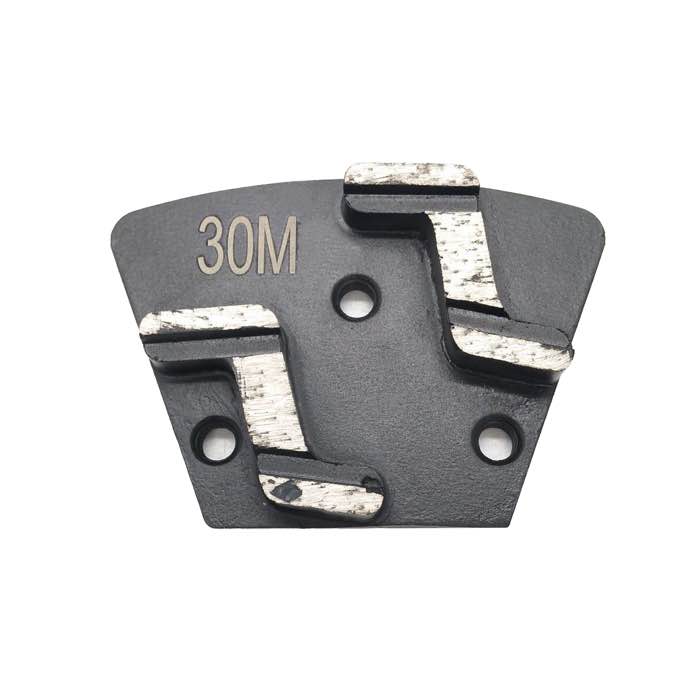
Use double-S trapezoid segments for general medium-pressure work; the S-shape keeps contact even under variable pressure. For WerkMaster-style machines, the single-bar segment carries head weight cleanly without digging in.
You do not need a load cell to tune pressure. Weigh the head with a bathroom scale: raise the head, place a scale under the segment contact area, lower gently, and read the weight off the scale. Divide by the number of segments to get kg per segment. That is the number you should compare against the chart above. Track it across jobs and across ballast changes so you can reproduce a good cut.
If your grinder has hydraulic down-pressure adjustment on a ride-on, log the setting (psi or %) alongside MPSI of the slab. Over time you will build a reference table: for example, '400 kg head, 3 bar down-pressure, 35 MPa concrete = 2.0 kg/segment, 120 m² per shoe set'.
One more tip: watch the swarf. Fine, uniform, dry dust means pressure is right. Coarse chunks, blue heat marks, or the smell of burning resin mean pressure is too high. A clean cut is the fastest cut.
Do not add ballast beyond the manufacturer's plate rating. Ride-on grinders are balanced for a specific head weight; overloading wears the gearbox, throws a belt, or tips the machine on a slope. Walk-behind planetary machines typically accept 20-40 kg of added ballast, but check the manual. Single-disc machines rarely need ballast at all - they already rely on operator pressure.
Re-balance the head after adding ballast. An off-balance head chatters, leaves crescent marks, and wears segments unevenly. If you cannot re-balance at the shop, do not add the weight on site.
Log pressure settings on every job. Over a season you will build a reference table: concrete age, MPSI, head weight, ballast, down-pressure, tool life per set. That table is what separates a seasoned contractor from one who re-learns the bond chart every Monday.
No. Deep cut per pass sounds fast, but it leaves deep scratches that cost many extra resin passes to remove. Take shallow, steady cuts - they finish faster overall.
Usually uneven down-pressure from the operator leaning on one handle, or a head that is not flat on the floor. Re-level the machine, stand centered, and let planetary rotation do the work.
Burning smell, blue discoloration on segments, visible deep gouges instead of uniform swarf, and the machine slowing down. Back off immediately.
Yes. Heavy pressure at 30/40 grit creates a deeper scratch pattern that requires 80/100 grit to remove. Light pressure at every step leaves a shallower scratch pattern and fewer passes to get to 400 grit.
Head weight is a tuning dial, not a power switch. Start at the manufacturer's recommended ballast, watch the swarf and segment wear, and adjust by 0.5 kg per segment at a time. JOY TECH publishes recommended down-force ranges on every trapezoid datasheet; ask us for the chart matched to your grinder model.
Written and reviewed by JOY TECH - an SGS & BV audited, CE/RoHS certified diamond tools manufacturer founded in 2004, exporting to 50+ countries.
Our factory and quality management system are audited by SGS and Bureau Veritas. Products meet CE/RoHS requirements and every piece is 100% inspected before packing.
Verified Certificates
