Average response time: under 24 hours
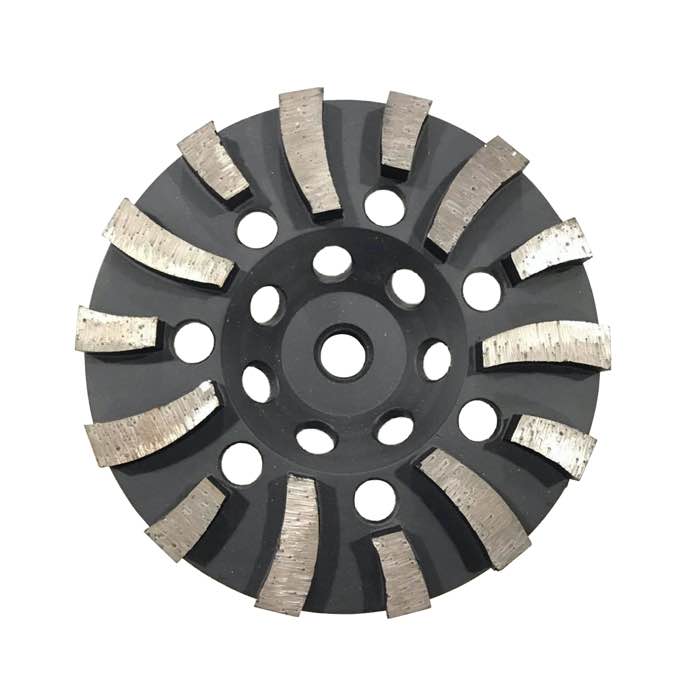
Trowel marks are the circular swirl pattern left by the power trowel pan and blades. Grind them out with a 30/40 or 60/80 metal-bond disc such as triple-round trapezoid segments on a planetary grinder, working in a cross-hatch until the swirl disappears under angled light. Do not try to remove trowel marks with resin pads alone - they are 0.2-0.5 mm deep and require an aggressive metal cut. After the marks are gone, continue through 150 metal and the resin sequence to polish.
A power trowel is a rotating disc with blades that smooth wet concrete. When the operator finishes too early, too late, or with the pan at the wrong angle, the blade leaves circular ridges 0.1-0.5 mm deep. On raw concrete you barely see them; on polished concrete they show as a repeating swirl that reflects every light fixture.
Start too fine and you spend all day. Start too coarse and you leave scratches that take 4 extra grits to remove. Rule of thumb: start at 30/40 on fresh floors, 60/80 on older power-troweled slabs where the marks are fine. Run a 1 m test patch first and inspect with a work light at 15 degrees angle. If swirl still shows after 2 passes, drop to 30/40.
| Mark type | Starting grit | Passes |
|---|---|---|
| Deep pan marks | 30/40 metal | 2-3 cross passes |
| Moderate swirl | 60/80 metal | 2 cross passes |
| Fine blade tracks | 80/100 metal | 1-2 passes |
Trowel swirl runs in a circle. Fight it with straight lines: run north-south, then east-west, then north-south again. Do not follow the swirl. Keep the grinder moving and do not press hard - the disc weight is enough. A double-bar trapezoid disc cuts trowel marks faster than a round segment because the bar edges shear the raised swirl ridges.
After trowel marks are gone, transition through a ceramic-bond transitional pad before resin so the metal scratches disappear cleanly.
A: No. Polished concrete is a mirror; every 0.1 mm ridge reflects light. Trowel marks look worse after polishing, not better.
About 20-30% of the total grinding time. On a 500 sqm floor, budget one extra day for the trowel-mark removal stage.
Only if you did not grind deep enough. Once removed at 60/80 metal, they stay gone. If they reappear, you only polished the surface without grinding off the ridges.
Dry with extraction so you can see the scratch pattern. Wet grinding hides trowel marks until the floor dries.
Trowel marks are a grinding problem solved at the metal stage, not the resin stage. Start at the right grit, cross-hatch against the swirl, and inspect with angled light. JOY TECH supplies the 30/40 and 60/80 trapezoid discs used to remove power-trowel marks; tell us your floor age and trowel finish for a recommended starting grit.
Written and reviewed by JOY TECH - an SGS & BV audited, CE/RoHS certified diamond tools manufacturer founded in 2004, exporting to 50+ countries.
Our factory and quality management system are audited by SGS and Bureau Veritas. Products meet CE/RoHS requirements and every piece is 100% inspected before packing.
Verified Certificates
