Average response time: under 24 hours
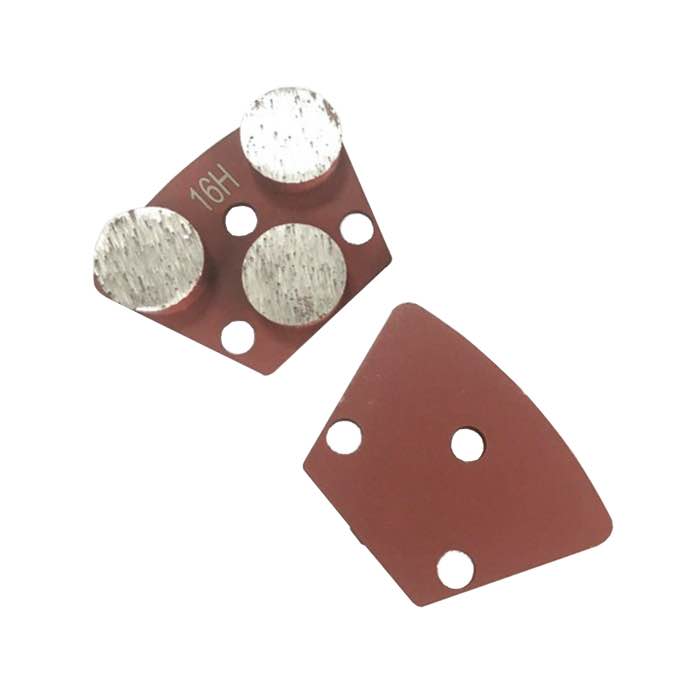
Rake marks and rough surfaces come down to the same root causes: machine condition, tooling match and technique. Start with coarse 30/46-grit stage metal-bond discs on a walk-behind grinder, work the whole deck, then progress through 80, 150 and optionally 300-grit stage resin pads. Diamond abrading removes the thin, weakened laitance and sharp surface layer that catches bare feet, leaving a level, even, anti-slip surface.
For machine-matched tooling, browse our 3'' Metal Bond Diamond Grinding Disc with 4 Segments range.A closer look at the details.
Aggressive exposed aggregate, weathering, and efflorescence make the deck surface feel like sandpaper under bare feet.
Getting this part right saves a full re-pass later.
What you should know before starting.
A common starter set on a Husqvarna-style equipment is a coarse metal disc such as a Husqvarna single-bar segment disc at 30 grit stage for aggressive stock stripping, followed by 60/80 grit stage to begin flattening.
Use a 270-580 mm planetary or single-disc walk-behind grinder matched to your plate system.
Contractors who skip this stage usually end up redoing the floor.
The key points in practice.
Abrade in overlapping 30-40% passes, keeping the equipment moving.
This is where most crews get it right - or lose time.
A closer look at the details.
Bare burnished outdoor concrete wears and stains.
Getting this part right saves a full re-pass later.
What you should know before starting.
Contractors who skip this stage usually end up redoing the floor.
The key points in practice.
Fill cracks wider than 3 mm with a flexible concrete caulk, and fill popouts with a fast-setting cementitious material patch, letting it cure 24 hours before abrading.
This is where most crews get it right - or lose time.
A closer look at the details.
Whichever equipment you rent, confirm the plate system matches your discs (Husqvarna Redi-Lock, Lavina, WerkMaster, etc.) before leaving the yard.
Getting this part right saves a full re-pass later.
What you should know before starting.
This is also the moment to round sharp control-joint edges slightly so they do not catch bare feet.
Contractors who skip this stage usually end up redoing the floor.
A: For most jobs, No — if you stop around 150-300 grit stage and use a non-slip additive in the sealing layer, the deck stays grippy. Stop at 50 grit stage if you want a more aggressive texture; go beyond 300 grit stage only indoors.
A: In short, In most cases 0.5-1.5 mm is enough to take off the coarse layer. Do not abrade deeper than 2 mm on a thin residential slab, or you risk weakening the top.
A: The practical answer is, For a small deck, yes with a cup wheel, however you will leave swirl marks. Renting a walk-behind grinder gives a level, even outcome and is far faster.
A: For most jobs, Wait until the deck is fully cleaned and the sealing layer has cured (in most cases 24-48 h). Wash away grinding slurry before it runs into the pool.
Looking for the right tool? Check our 3'' Metal Bond Diamond Grinding Disc with 10 Segments. Looking for the right tool? Check our 3'' Metal Bond Diamond Grinding Disc with 5 Segments.Match the tooling to the concrete, keep the machine in good condition, and run even passes - the finish follows. A controlled diamond-abrading sequence with the right metal and resin bonds restores a comfortable, barefoot-friendly surface and buys you years before any resurfacing is due.
Written and reviewed by JOY TECH - an SGS & BV audited, CE/RoHS certified diamond tools manufacturer founded in 2004, exporting to 50+ countries.
Our factory and quality management system are audited by SGS and Bureau Veritas. Products meet CE/RoHS requirements and every piece is 100% inspected before packing.
Verified Certificates
