Average response time: under 24 hours
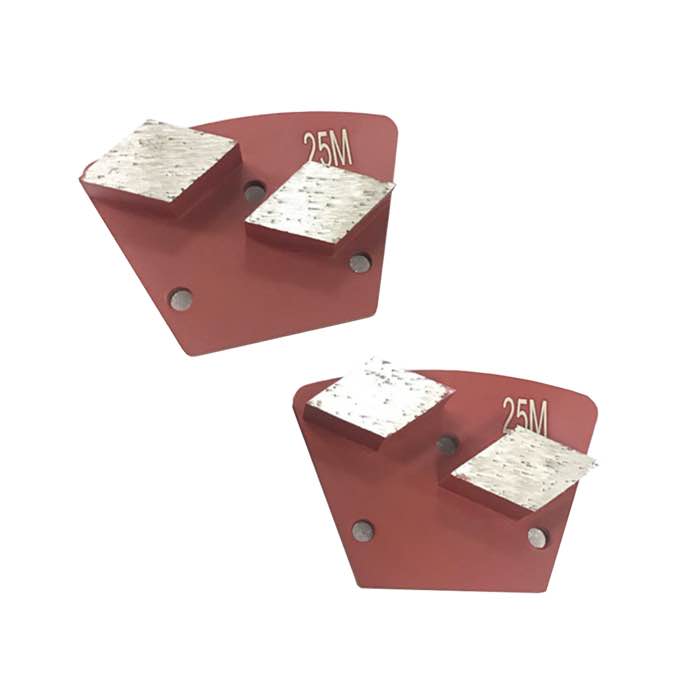
The right answer depends on the concrete condition, age and moisture. The fastest way to even a pitted, coarse basement slab is to abrade it level with a planetary floor abrading equipment, starting with 30/40 grit stage metal-bond diamonds and finishing at 120–200 grit stage, then patch active holes with a cementitious material repair mortar before installing epoxy resin, tile or a burnished finish. Use medium to soft matrix discs like Double Rhombus Trapezoid Disc (JOY-TP-RH2) on older, hard basement concrete, and take time to fix moisture issues before any coating layer goes down.
For machine-matched tooling, browse our Diamond Trapezoid Grinding Disc (JOY-TP-R3) for Floo... range.What this means on site.
Basement slabs are frequently coarse because they were placed as a structural sub-floor, never intended for finishing.
The slab condition drives every decision after this point.
Key points to understand.
This is where the concrete makes its own rules.
The background.
Tooling like Double Rhombus Trapezoid Disc (JOY-TP-RH2) handles the middle abrading stages on medium-hard basement concrete; for very old, hard slabs, drop to a softer bond.
For coating layer stripping on old basement glue layer, WerkMaster PCD Tooling (JOY-WM-PCD1R1) PCD tooling clears cutback and mastic before diamond abrading begins.
Understanding the material explains the symptoms.
What this means on site.
Abrading alone cannot fill pits larger than a few millimeters.
The slab condition drives every decision after this point.
Key points to understand.
This is where the concrete makes its own rules.
The background.
Silica fine dust plus trapped moisture is a respiratory and drying hazard.
Understanding the material explains the symptoms.
What this means on site.
The slab condition drives every decision after this point.
A: For most jobs, You can skim-coat with a self-leveling overlay system, but the slab must still be profiled (ground or shot-blasted) for the overlay system to bond. Abrading is the fastest, cheapest route.
A: In short, Roughly 0.3–1.0 mm. Enough to strip laitance, trowel marks and old glue layer, but not so much that you weaken the slab. If aggregate starts popping out, you are going too deep.
A: The practical answer is, That is laitance or a weak surface. Abrade until you hit sound concrete, after that apply a lithium densifying sealing layer before coating layer. Dusting that returns after abrading in most cases means high moisture—address the source.
A: For most jobs, Yes, but keep the space above 10°C for abrading and coating layer. Cold grinding slurry freezes on tools and slows cementitious material patch curing.
Looking for the right tool? Check our Single Rhombus Segment Diamond Trapezoid Grinding Di.... Looking for the right tool? Check our Double Rhombus Segment Diamond Trapezoid Grinding Disc.Read the concrete first, then choose the method - the results follow. A walk-behind grinder with discs like Double Rhombus Trapezoid Disc (JOY-TP-RH2) and PCD tooling like WerkMaster PCD Tooling (JOY-WM-PCD1R1) will turn a pitted slab into a clean, level surface ready for epoxy resin, tile or glossy concrete—far faster and flatter than hand angle abrading alone.
Written and reviewed by JOY TECH - an SGS & BV audited, CE/RoHS certified diamond tools manufacturer founded in 2004, exporting to 50+ countries.
Our factory and quality management system are audited by SGS and Bureau Veritas. Products meet CE/RoHS requirements and every piece is 100% inspected before packing.
Verified Certificates
