Average response time: under 24 hours
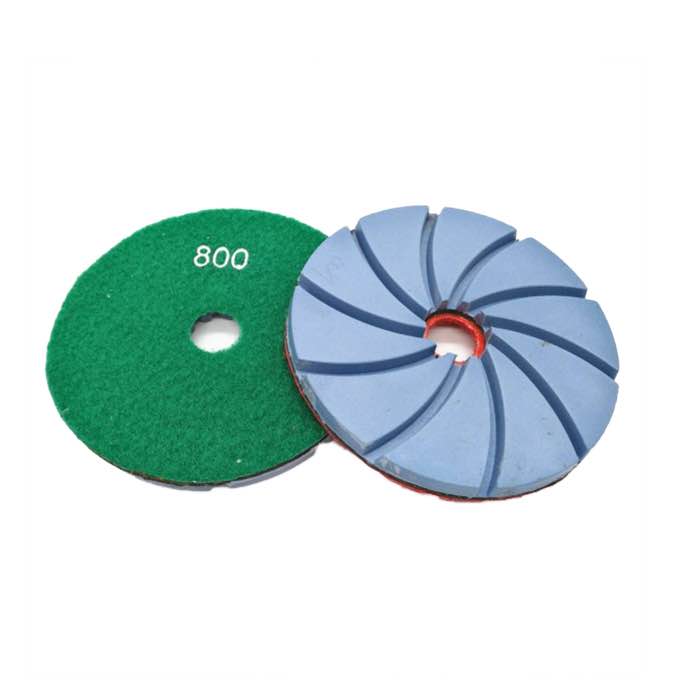
Polish concrete to 150 or 200 grit before applying dye - not to high gloss. Dye needs an open, clean surface to penetrate; a floor polished to 800 grit will not absorb dye and will show it as a sitting film. Grind through 30/40, 60/80, 150 metal, then use a ceramic transitional pad to open the pores, vacuum thoroughly, and apply dye. After dye dries, continue through 400, 800, 1500 and 3000 to polish the color in.
Concrete dye (both acid-based and water-based) works by absorbing into the cement paste. At 150 grit, the surface is open and porous - the dye sinks in 0.1-0.2 mm. At 800 grit, the surface is densified and polished shut; dye sits on top and looks painted. The industry standard is 150-200 grit for dye application.
You are not polishing for gloss at this stage - you are profiling the floor for dye. Sequence: 30/40 metal (remove laitance), 60/80 metal (open), 150 metal (uniform scratch), then a ceramic transitional pad at 200. Stop. Vacuum with Hepa, blow compressed air into pores, then apply dye.
| Step | Grit | Goal |
|---|---|---|
| Coarse grind | 30/40 metal | Open surface |
| Flatting | 60/80 metal | Remove laitance |
| Dye prep | 150-200 ceramic | Even porosity |
| Dye | - | Absorb color |
| Post-dye | 400, 800, 1500, 3000 resin | Polish color in |
Blotchy dye almost always comes from uneven surface prep. The slab must be uniformly rough before dye. A copper-bond transitional pad at 200 grit evens out porosity differences between troweled and ground areas. Do not densify before dye - densifier closes pores and blocks dye absorption. Densify after dye is dry.
After dye dries and densifier cures, finish with resin polishing pads at 400, 800, 1500, 3000 to bring the color to a wet look.
A: Yes, but you must re-grind it back to 150 grit first. Dye will not absorb into an 800-grit polished surface.
After dye. Densify closes pores once the dye has absorbed. Densifying first blocks the dye.
Wait 4-6 hours (or overnight) for water-based dye to dry. Acid stain needs 24 hours and a neutralizing wash before polishing.
Either the surface was not uniformly ground, or dye was applied too fast. Re-grind to 200, re-vacuum, and apply dye in two thin coats.
Dye lives or dies by surface prep: 150-200 grit, uniform scratch, no densifier, perfect vacuum. Then polish the color in through 3000. JOY TECH supplies ceramic transitionals and the full resin pad set for dyed floors; tell us your dye type for the prep sequence.
Written and reviewed by JOY TECH - an SGS & BV audited, CE/RoHS certified diamond tools manufacturer founded in 2004, exporting to 50+ countries.
Our factory and quality management system are audited by SGS and Bureau Veritas. Products meet CE/RoHS requirements and every piece is 100% inspected before packing.
Verified Certificates
