Average response time: under 24 hours
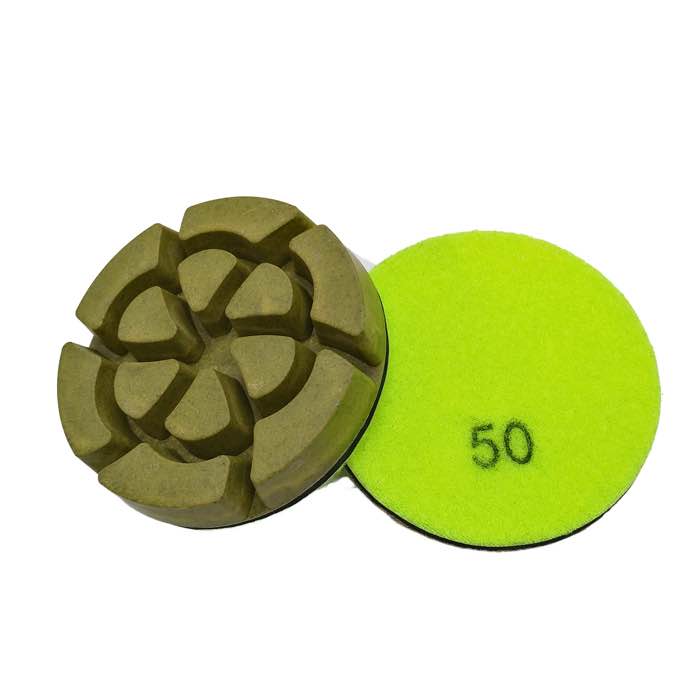
Concrete countertops and floors both use diamond resin pads from 50 to 3000, but the process is almost inverted: floors are dry-polished with planetary machines, densified in place, and burnished for gloss. Countertops are wet-polished by hand on a precast piece, sealed with topical epoxy or polyurethane, and finished to a higher gloss because the surface is viewed from 50 cm. Countertop pads are 3-inch (75-100 mm) on a variable-speed angle grinder; floor pads are 17-20 inch plates on a walk-behind planetary. Do not try to polish a countertop with floor pad technique - it will overheat and haze.
The core difference is scale and setting:
Both end at 3000 grit, but everything in between is different.
| Factor | Concrete floor | Concrete countertop |
|---|---|---|
| Machine | Walk-behind planetary 400-800 mm | Variable-speed angle grinder 100-125 mm |
| Pad size | 4-16 segment plate, 400-800 mm | 3 inch (75-100 mm) pad |
| Wet or dry | Dry (wet rare) | Wet always |
| Speed | 600-1,500 RPM head | 1,500-3,000 RPM, low gear |
| Densifier | Lithium / potassium in sequence | Not used - topical sealer instead |
| Sealer | None or thin penetrating sealer | Epoxy / polyurethane topcoat |
| Grit sequence | 30, 40, 80, 100, 200, 400, 800, 1500, 3000 | 50, 100, 200, 400, 800, 1500, 3000 |
| Final gloss target | 50-80 GU (satin) to 100+ GU | High gloss, mirror-like 1,000+ GU |
Use 3-inch pads such as 3-inch diamond resin polishing pads - they fit standard angle grinders and are the same resin bond used on floors, just smaller.
For fabricators, a matched kit is: 3-inch resin pads 50 through 3000 in wet formula, a variable-speed angle grinder (1,000-4,000 RPM), and a water feed bottle. JOY TECH's 3-inch pad line is wet-capable and fits standard M14 angle-grinder backers.
Countertops need a food-safe sealer. Two options dominate:
Floor polished concrete uses no food-safe sealer because it is not a food contact surface. That is another reason the two processes diverge: the final step on a countertop is a coating; the final step on a floor is a burnish.
For fabricators selling both, keep two tooling kits separate. Mixing floor pads with countertop pads contaminates both - floor pads have heavier diamond load, and countertop pads wear fast on floors. Label and store them separately.
Countertops need rounded edges. After polishing the flat face, round the exposed edge with a 50-grit diamond pad wet, then sequence 100, 200, 400, 800, 1500 on the edge. A sharp 90-degree edge is a chip magnet and will fail in service.
For fabricators shipping countertops, polish in the shop, not on site. Field polishing of a countertop is messy, wet, and hard to match. Install the piece, do a light touch-up with 1500 wet pad, then apply sealer on site.
Not recommended. Small surface area = small heat sink. Dry polishing overheats the resin bond, glazes the pad, and leaves haze. Always wet.
Usually no. Countertops are precast with low water-cement ratio and are already dense. A topical sealer is what provides stain resistance.
No. Floor pads are 400+ mm wide. Use 3-inch (75 mm) pads on a variable-speed angle grinder for edges and curves.
Probably because you skipped wet steps at 800/1500, or the sealer is still tacky. Countertops need 3000 wet plus a sealer to reach mirror gloss. Floors get gloss from burnishing, not sealer.
Same diamond grits, almost opposite methods. Countertops: wet, hand-held, 3-inch pads, topical sealer. Floors: dry, planetary, multi-segment plates, densifier. JOY TECH supplies both lines - RFP-05 3-inch pads for fabricators and the full RFP floor range for contractors - ask for a matched sample kit.
Written and reviewed by JOY TECH - an SGS & BV audited, CE/RoHS certified diamond tools manufacturer founded in 2004, exporting to 50+ countries.
Our factory and quality management system are audited by SGS and Bureau Veritas. Products meet CE/RoHS requirements and every piece is 100% inspected before packing.
Verified Certificates
